Blog

Photo of Viktor Orban Library

Hungary: IPI welcomes EU legal action over violations of…

Hungary: IPI welcomes EU legal action over violations of European Media Freedom Act

The International Press Institute (IPI) today welcomes the launching of legal action by the European Commission against Hungary over its systematic violation of new rules set out in the European Media Freedom Act (EMFA).

12.12.2025

On 11 December, the EU Commission announced it had opened an infringement procedure against Hungary for failing to comply with several provisions under EMFA, including non-interference in journalistic and media work, economic pressure, and inadequate protection of sources and digital communications.


It also found that Hungary fails to comply with requirements relating to the public service media, the transparency of media ownership, the assessment of media market concentrations, the allocation of state advertising, and independent media regulation.


These findings echo the recent conclusions of a new report by IPI and the Media and Journalism Research Center, which examined the non-implementation of EMFA in Hungary in 2025 through the lens of media capture.


Overall, the report assessed that no action has been taken by Hungarian authorities to align domestic law with the EMFA and that Hungary remains the EU Member State with the most sophisticated model of media capture ever developed within the bloc.


Rather than take any steps to implement the EMFA, the government of Prime Minister Viktor Orbán has framed it as a tool of foreign interference and challenged the regulation before the European Court of Justice seeking to have elements annulled.


IPI welcomes the EU Commission’s opening of legal action over the non-implementation of EMFA, which represents an important use of its new regulatory toolbox for safeguarding media freedom, independence and pluralism within the EU’s internal market.


The infringement proceedings will represent a key litmus test for the strength of the EMFA moving forward and will be closely watched by other EU member states. However, due to the lengthy nature of the legal process, questions remain over its impact. The EU should therefore use all tools at its disposal to protect free media and democratic values in Hungary.


Earlier this month, IPI and partners in the Media Freedom Rapid Response (MFRR) wrote to the EMFA-established European Board for Media Services to raise alarm about the recent acquisition of Hungary’s most-read tabloid newspaper by a pro-government media group and called on the newly established body to launch an assessment of the merger and its potentially negative impact on media pluralism in Hungary.


IPI will closely follow both procedures and continue to support the fight for a free, independent and pluralistic media ecosystem in Hungary.


In November, IPI joined a fact-finding visit of international media freedom organisations to Budapest, which concluded that press freedom and independent journalism in Hungary remain in a period of deep crisis ahead of the 2026 election, amidst an enduring climate of political harassment and demonization.


At IPI’s recent World Congress, Hungary’s independent media were named the recipient of the 2025 IPI-IMS Free Media Pioneer Award in recognition of their innovation, adaptation, and endurance under sustained political and economic pressure.

Hungary Media Capture Monitoring Report 2025

The International Press Institute (IPI) and the Media and Journalism Research Center (MJRC) today jointly launch a new series of Media Capture Monitoring Reports for 2025, with Hungary the first country report to be published.

This statement was coordinated by IPI as part of the Media Freedom Rapid Response (MFRR), a Europe-wide mechanism which tracks, monitors and responds to violations of press and media freedom in EU Member States and Candidate Countries.

Allgemein

MFRR Summit 2025 report on media freedom in Europe

MFRR Summit 2025 Report on Media Freedom in Europe

This report offers a recap of the discussions and key takeaways from the MFRR Summit 2025. This year’s Summit fed into EU Democracy Shield policy discussions, highlighting journalism as vital democratic infrastructure. Drawing on MFRR’s monitoring, missions, and policy work, the event explored five key pillars of media resilience: economic viability, safety, legal protection, AI governance, and implementation of safeguards.

10.12.2025

The summit took place on October 13, in Brussels, and this report documents how journalists and media outlets across EU member states and candidate countries are confronting mounting economic pressure, legal harassment, physical and digital attacks, and threats emerging as a result of changing digital space. Drawing on five thematic panels and a special focus on Ukraine, it connects on-the-ground monitoring with concrete policy debates on issues such as the European Media Freedom Act, anti-SLAPP measures, spyware, and foreign agent laws, offering both an overview of violations and a roadmap for strengthening journalism as a vital part democratic processes.​

This report was coordinated by the ECPMF and IPI as part of the Media Freedom Rapid Response (MFRR), a Europe-wide mechanism which tracks, monitors and responds to violations of press and media freedom in EU Member States and Candidate Countries.

Event

Jailed for dissent: Georgian journalists and writers under crackdown

Jailed for dissent

Georgian journalists and writers under crackdown

Friday, 12 December 2025 at 11:00 am CEST.

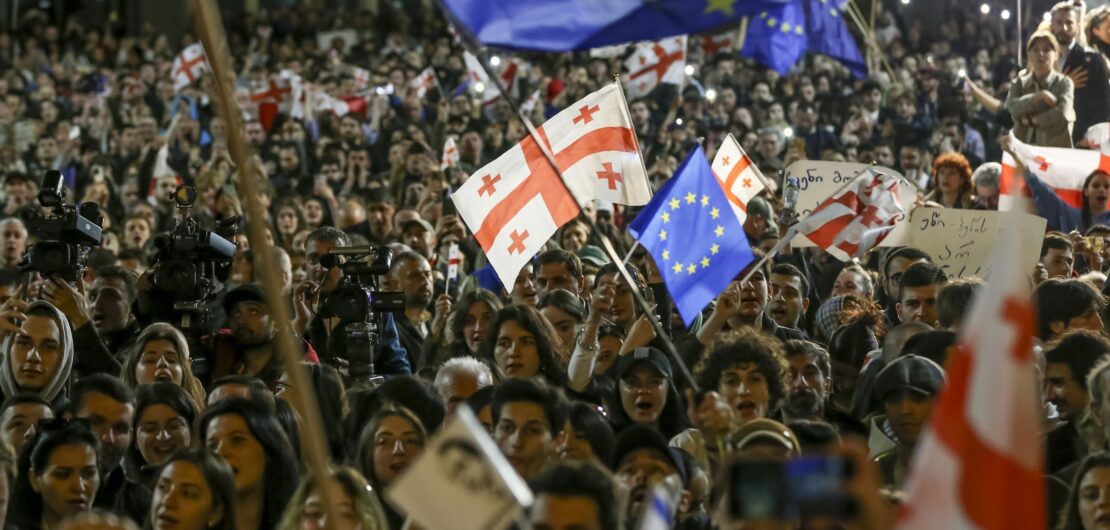
On August 6, 2025, after more than 200 days of unjust pretrial detention and a highly politicized trial, Georgian journalist and Sakharov Prize laureate Mzia Amaglobeli was sentenced to two years in prison, as the world watched and protesters gathered outside a courtroom in Batumi, Georgia. She is the first female journalist to be imprisoned in Georgia’s 34 years of independence.


Mzia is being targeted and punished for her decades-long work and dedication to independent reporting that exposes corruption, political repression, and human rights violations.


She is the first female journalist imprisoned in Georgia since the fall of the Soviet Union. Georgia now has over 60 political prisoners, most of them jailed during the wave of protests that erupted after the October 28, 2024, elections and the ruling party’s subsequent announcement about halting EU integration. 


Since October 28, Mapping Media Freedom recorded 117 attacks on media freedom involving 312 journalists. Among them 31 journalists have been subjected to arbitrary and unjust arrests.


Among those jailed for dissent is Zviad Ratiani, renowned Georgian poet sentenced to two years in prison under grossly disproportionate charges of assaulting a police officer. 


The ruling Georgian Dream party is entrenching authoritarian rule not only through elections, but also through the systematic capture of the judiciary, turning it into a tool for stifling dissent and protecting those in power.


To mark the International Human Rights Day on December 10 and the awarding of Mzia Amaglobeli with the Sakharov Prize on December 16, MFRR is shining a spotlight on Georgia – a country once regarded as a beacon of democracy in the South Caucasus, now moving closer each day toward fully consolidated authoritarianism.


We will examine the attacks on media freedom, independent journalism and freedom of expression in Georgia, explore how those jailed for speaking out can be supported by the international community, and the ways to reverse the country’s authoritarian drift.


This webinar is organised in partnership with PEN International, joining efforts to defend free expression and support Georgian journalists targeted for dissent.

Speakers

Irma Dimitradze

Communications Manager and Journalist at Batumelebi and Netgazeti

Khatuna Tskhadadze

PEN Georgia President

Kety Abashidze

Senior Human Rights Officer at Human Rights House Foundation

Moderator

Teona Sekhniashvili

Europe Advocacy Officer at the International Press Institute (IPI) 

Library

Spain: Media Capture Monitoring Report 2025

Spain: Media Capture Monitoring Report 2025

The International Press Institute (IPI) and the Media and Journalism Research Center (MJRC) today publish a new report examining the level of media capture in Spain and the country’s compliance with the new European Media Freedom Act (EMFA) in 2025.

05.12.2025

The report – the seventh in a series of Media Capture Monitoring Reports for 2025 – reviews developments regarding media capture in Spain and assesses the country’s compliance with EMFA since the EU Commission’s regulation entered into full force in August 2025.

While other reports in the series are an update from the 2024 report, Spain is the newest country added to the series and provides a new assessment of media capture in the country through IPI and MJRC’s methodology.


The Spanish report focuses on EMFA elements directly addressing media capture: the independence of public service media and of media regulators, the misuse of state funds to influence media, and ensuring ownership transparency and media pluralism.


The report examines the standards prescribed by law and how they are currently implemented in practice. It also sets out the areas of reform needed to bring the country into line with EMFA while also making recommendations for where reform can go further.

EXPLORE THE METHODOLOGY
For more information or media inquiries, please contact:
  • Jamie Wiseman, Senior Europe Advocacy Officer – IPI, jwiseman@ipi.media
  • Marius Dragomir, Project Editor – MJRC, mdragomir@journalismresearch.org

This report was coordinated by IPI as part of the Media Freedom Rapid Response (MFRR), a Europe-wide mechanism which tracks, monitors and responds to violations of press and media freedom in EU Member States and Candidate Countries.

Allgemein

Open letter to Croatian Prime Minister Plenković: MFRR raises…

Open letter to Croatian Prime Minister Plenković: MFRR raises alarm over unlawful political pressure against weekly Novosti

Media Freedom Rapid Response (MFRR) consortium, expresses grave concern regarding recent statements by the Homeland Movement that targeted the weekly newspaper Novosti, the only print media for the Serb minority in Croatia.

05.12.2025

Dear Prime Minister of Croatia Andrej Plenković, 


We, the Media Freedom Rapid Response (MFRR) consortium, express our grave concern regarding recent statements by the Homeland Movement that targeted the weekly newspaper Novosti,  the only print media for the Serb minority in Croatia. Specifically, MP Mlinarić publicly announced the Homeland Movement’s intention to completely abolish state funding for Novosti starting in 2026. This statement followed reports by Novi List that the president of the Homeland Movement, Ivan Penava, had allegedly pressured minority members of the Council for National Minorities not to ‘protect the interests of Novosti’.


Such an announcement, including claims of political influence over the decisions of the Council for National Minorities, constitutes an unlawful interference in the independence of a public institution and a direct violation of the Constitutional Act on the Rights of National Minorities. 


Financing of minority media must be conducted through an open public call and remain completely independent of political pressure in line with the European Media Freedom Act (EMFA). 


The MFRR already issued a warning about political pressure after Novosti‘s 2025 budget was dramatically reduced by 35% compared to the previous year, despite a 13.3% increase in the Council for National Minorities’ overall annual budget. We viewed this reduction as being driven by the far-right Homeland Movement, which included calls for defunding the magazine in its election manifesto due to its critical reporting. 


During our in-person mission to Croatia last May, the continuous targeting of Novosti was a crucial topic in our meetings, where we expressed absolute alarm at the rising signs of increased political pressure on the media and journalists.  


Media freedom is not only a cornerstone of democracy but also an international obligation of the Republic of Croatia as a member state of the European Union. Political pressure on the media — especially on minority media — represents a serious breach of European standards and a threat to media pluralism.  


 An alert regarding the situation has already been submitted to the Mapping Media Freedom and the Council of Europe safety of journalists platform. 


Therefore, we urge Croatian authorities to ensure the independence of the Council for National Minorities, guarantee the protection of minority media, and cease any form of political pressure on journalists and media outlets.

Signed by:

  • European Federation of Journalists (EFJ)  
  • European Centre for Press and Media Freedom (ECPMF)
  • Osservatorio Balcani Caucaso Transeuropa (OBCT)
  • Free Press Unlimited (FPU)
  • ARTICLE 19 Europe
  • International Press Institute (IPI)

This statement was coordinated by the Media Freedom Rapid Response (MFRR), a Europe-wide mechanism which tracks, monitors and responds to violations of press and media freedom in EU Member States and Candidate Countries.

Library

Finland: Media Capture Monitoring Report 2025

Finland: Media Capture Monitoring Report 2025

The International Press Institute (IPI) and the Media and Journalism Research Center (MJRC) today publish a new report examining media capture in Finland in 2025 and the country’s compliance with the European Media Freedom Act (EMFA).

04.12.2025

The report – the sixth in a new series of Media Capture Monitoring Reports for 2025 – reviews developments regarding EMFA in Finland – a country with one of one of the healthiest climates for press freedom in the world.

While other country reports in the series so far highlight engrained challenges for media capture and either slow or delayed implementation of EMFA, Finland is among the EU countries to have made the most progress on aligning domestic laws with provisions laid out under EMFA and offers a positive example of EU-mandated media reform.


Overall, the Finnish media ecosystem does not suffer from media capture due to a combination of strong legislation, forceful regulatory systems and healthy political and business practices.


Instead, due to its strong track record in media, communication, and democracy, Finland is often classified as a “media welfare state,” where communication services are traditionally regarded as public goods and editorial independence is actively encouraged – significantly limiting the space for the problematic capture and control of media.


Implementation on EMFA in Finland started back in October 2024 has since resulted in the adoption of the Act on the Supervision of Media Markets and several amendments to existing laws, designed to ensure compliance with EMFA’s core provisions while introducing minimal additional changes.


The report concludes that, in practice, this implementation in Finland has resulted in targeted additions to national legislation that ensure compliance without extending regulation beyond the scope of EMFA’s main provisions.


This report is part of a broader series covering seven other EU countries: Bulgaria, Greece, Hungary, Poland, Romania, Slovakia and Spain.


IPI and MJRC will also publish an overview report, summarising major developments across the EU in the past year. The next reports will be published in the coming weeks.


These reports are intended as a resource for media rights organizations, civil society groups, policymakers, and advocates dedicated to monitoring and fostering media freedom across the EU.

EXPLORE THE METHODOLOGY
For more information or media inquiries, please contact:
  • Jamie Wiseman, Senior Europe Advocacy Officer – IPI, jwiseman@ipi.media
  • Marius Dragomir, Project Editor – MJRC, mdragomir@journalismresearch.org

This report was coordinated by IPI as part of the Media Freedom Rapid Response (MFRR), a Europe-wide mechanism which tracks, monitors and responds to violations of press and media freedom in EU Member States and Candidate Countries.

Allgemein

Lithuania: Media freedom groups raise alarm as political pressure…

Lithuania: Media freedom groups raise alarm as political pressure campaign on LRT widens

Proposed legal amendments to the law governing Lithuania’s public broadcaster LRT risk weakening its editorial independence and disrupting its sustainable financing, the undersigned partner organisations of the Media Freedom Rapid Response (MFRR) warn today.

4.12.2025

Earlier this week, LRT journalists announced a protest scheduled for 9 December in front of the Parliament to oppose proposed changes to the Law on the Lithuanian National Radio and Television, which they say would “dismantle the safeguards that protect LRT’s independence.”


The protest is organised in reaction to two amendments initiated by the governing Nemunas Dawn party, which is part of the ruling parliamentary majority, which targeted both LRT’s budget and the rules governing the dismissal of its Director General.


On 25 November, lawmakers voted to freeze LRT’s annual budget at €79.6 million for 2026, 2027, and 2028, overriding the existing mechanism that would have increased the broadcaster’s funding by roughly 11% next year, according to LRT. The budget change was made without proper consultation with LRT management.


Meanwhile, a proposed legal amendment that would lower the threshold for dismissing the Director General, allowing the LRT Council to remove the head of the broadcaster with a simple majority rather than the current two-thirds requirement, was passed the first reading in Parliament on 27 November. We are concerned that this would open the door to greater political pressure on the LRT’s management and potentially violate Article 5 of the European Media Freedom Act, which obliges Member States to ensure that procedures for the appointment and dismissal of PSM leadership “aim to guarantee the independence of the public service media.”


Our organisations further warn that these legislative reforms follow the results of an internal audit conducted in 2025 to assess LRT’s performance, particularly its “political neutrality” for the period 2021-2024. The audit report, published in November, identified areas for improvement but overall found that the public broadcaster operates efficiently and transparently, and did not identify any editorial bias.


As feared, in the recent weeks politicians from Nemunas Dawn and other coalition parties have instrumentalised the audit findings to attack the public broadcaster, question its funding and governance, and justify attempts to increase political control over LRT. Our organisations repeatedly raised concerns about the scope, nature and justification for such an audit and its potential impact.


Ahead of the planned strike, MFRR partners urge political parties to reject the proposed legislative amendment to the LRT law. Moving forward, any such proposed changes should be put to public consultation, with input from expert national and international journalists and media freedom groups, as well as input from LRT management itself. MFRR partners will continue to closely monitor the situation and alert European institutions about emerging threats to media freedom in Lithuania.

Signed by:

  • European Federation of Journalists (EFJ)
  • European Centre for Press and Media Freedom (ECPMF)
  • Free Press Unlimited (FPU)
  • International Press Institute (IPI)
  • Osservatorio Balcani Caucaso Transeuropa (OBCT)

This statement was coordinated by the Media Freedom Rapid Response (MFRR), a Europe-wide mechanism which tracks, monitors and responds to violations of press and media freedom in EU Member States and Candidate Countries.

Allgemein

Ukraine: Peace plan must ensure accountability for crimes against…

Ukraine: Peace plan must ensure accountability for crimes against journalists

As negotiations continue over a peace plan to end the Russian war on Ukraine, Media Freedom Rapid Response (MFRR) and partner organisations strongly oppose any proposals on granting amnesty for potential war crimes committed in the course of Russia’s full-scale invasion, especially for those against journalists.

04.12.2025

Our organisations renew our demand that those responsible for the killing of at least 16 journalists, the serious injury of dozens more, as well as for other attacks on media infrastructure, are identified and held accountable for potential war crimes under international law and relevant domestic law. Investigations should rely, among other sources, on the expertise of Ukrainian journalists and media, who have already contributed to uncovering facts linked to potential war crimes targeting journalists.


We make this call in reaction to the initial 28-point plan proposed by the Trump administration that contained a provision giving “full amnesty” for all acts committed during the course of the war. While later reports suggest that this provision is no longer on the negotiating table, MFRR partners stress that any attempt to introduce blanket amnesty that covers potential war crimes committed against journalists, or civilians, would represent a severe breach of international law including international humanitarian law and relevant human rights obligations. 


All warring parties must protect journalists, as civilians, during times of armed conflict, according to international humanitarian law. The deliberate targeting of journalists, as civilians, as well as media infrastructure, constitutes a war crime, and must be investigated as such under the Rome Statute of the International Criminal Court (ICC) and relevant domestic law. Any form of amnesty for such violations would lack legal grounds.


In addition to supporting war crimes investigations by the ICC and the Ukrainian judiciary, our organisations endorse efforts by the Council of Europe (CoE) to establish a Special Tribunal for the Crime of Aggression against Ukraine, which would facilitate the investigation of crimes not covered by the mandate of the ICC. We urge CoE member states to accelerate the process of the creation of this tribunal, which should have all means at its disposal to conduct investigations into crimes committed in Ukraine, including those committed against journalists and the media.


Due to Russia’s full-scale invasion, at least 16 media workers have been killed while carrying out their professional duties covering this conflict – including Ukrainian journalist Victoria Roshchyna, who died after being tortured while in Russian captivity in 2024. Of these 16 media workers, some were executed, while others died from artillery fire or lately due to Russian first-person view (FPV) drone attacks. This includes French photojournalist Antoni Lallican, who was killed by a Russian FPV drone in eastern Ukraine in October 2025, and Ukrainian reporters Aliona Hramova and Yevhen Karmazin who were killed in another Russian drone attack in Donetsk region weeks later.


As of November 2025, the MFRR has also documented 53 cases in which Russian armed forces destroyed Ukrainian media infrastructure. We further note that peace discussions this month follow one of the deadliest periods for journalists in Ukraine since the start of Russia’s full-scale invasion in February 2022. As reported by monitoring bodies in Ukraine, this increase in targeted attacks on journalists wearing PRESS vests has created an increasingly dangerous security situation for journalists and media workers reporting from the front lines.


We therefore strongly urge all parties involved in peace deal discussions – including the U.S. and the E.U – not to agree to any measures granting amnesty for war crimes committed against journalists, as civilians. Any such concessions would dramatically undermine international treaties and international humanitarian law, set a dangerous legal precedent, and send a signal to the world that attacks against journalists and civilians can go unpunished.

Signed by:

  • International Press Institute (IPI)
  • European Centre for Press and Media Freedom (ECPMF)
  • Free Press Unlimited (FPU)
  • Institute of Mass Information (IMI)
  • Reporters sans frontières (RSF) / Reporters without Borders
  • Osservatorio Balcani Caucaso Transeuropa (OBCT)
  • ARTICLE 19 Europe

This statement was coordinated by the Media Freedom Rapid Response (MFRR), a Europe-wide mechanism which tracks, monitors and responds to violations of press and media freedom in EU Member States and Candidate Countries.

Library

Slovakia: Media Capture Monitoring Report 2025

Slovakia: Media Capture Monitoring Report 2025

The International Press Institute (IPI) and the Media and Journalism Research Center (MJRC) today publish a new report examining media capture in Slovakia in 2025 and the country’s compliance with the European Media Freedom Act (EMFA).

28.11.2025

The report – the fifth in a new series of Media Capture Monitoring Reports for 2025 – reviews developments regarding media capture and control in Slovakia over the past year and assesses the country’s compliance with EMFA since the EU Commission’s regulation entered into full force in August 2025.

It concludes that though legislation adopted in 2025 addressed some areas of the EMFA, the regulation has only been partially adopted, and major overhaul of the public broadcaster by the coalition government of Prime Minister Robert Fico directly violated EMFA rules on independent public service broadcasting.


With the explicit political aim of capturing public service broadcasting, the government dissolved the public broadcaster RTVS and established a new entity, STVR, which is controlled exclusively by pro-government appointees. By 2025, these appointees had already implemented measures demonstrating that the direction of reform was toward a less independent and more politically captured broadcaster, in clear violation of the EMFA.


Examining these developments in detail, the report provides recommendations on a variety of measures and policies necessary to address media capture in Slovakia and create a free, pluralistic and democratic media ecosystem, in line with EMFA provisions.


This report is part of a broader series covering seven other EU countries: Bulgaria, Finland, Greece, Hungary, Poland, Romania and Spain.


IPI and MJRC will also publish an overview report, summarising major developments across the EU in the past year. The next reports will be published in the coming weeks


These reports are intended as a vital resource for media rights organizations, civil society groups, policymakers, and advocates dedicated to monitoring and fostering media freedom across the EU.

EXPLORE THE METHODOLOGY
For more information or media inquiries, please contact:
  • Jamie Wiseman, Senior Europe Advocacy Officer – IPI, jwiseman@ipi.media
  • Marius Dragomir, Project Editor – MJRC, mdragomir@journalismresearch.org

This report was coordinated by IPI as part of the Media Freedom Rapid Response (MFRR), a Europe-wide mechanism which tracks, monitors and responds to violations of press and media freedom in EU Member States and Candidate Countries.

Bosnia media freedom Allgemein

Open letter: Bosnian public broadcaster BHRT in the final…

Open letter: Bosnian public broadcaster BHRT in the final stage of collapse, EU must take swift action

27 November 2025

Dear President of the European Commission, Ms Ursula von der Leyen,

Dear Commissioner for Enlargement, Ms Marta Kos,

We are writing to you today to express our serious concerns regarding the future of Bosnia and Herzegovina’s state-level broadcaster, Radio-Television of Bosnia and Herzegovina (BHRT). Our letter comes as BHRT staff today protest in front of Parliament of Bosnia and Herzegovina to raise alarm about the dire financial situation and call for institutional support and immediate action that will end years of disrespecting the Law.

For years, BHRT has been facing serious financial challenges due to a deep institutional crisis and debts primarily incurred by entity-level broadcaster RTRS, which has brought the national public broadcaster to the brink of collapse. Politicians have openly disregarded the law, resulting in only minimal funds reaching BHRT, against a backdrop of inter-entity funding disputes.

According to staff, the situation has now reached a point where accounts may be frozen and electricity and gas cut off at any moment. On 21 November, programs were interrupted for three hours due to the loss of power supply and the intermittent non-functioning of the entire system – most likely because of water penetrating the electrical installations during heavy rains. BHRT’s central building is in very poor condition and lacks funds for maintenance. The entity public service FTV, which operates from the same building, also experienced an interruption. Furthermore, the financial situation of BHRT puts some 780 employees from the entire state in a situation of constant precarity and fear of losing even the minimum income they have.

In an appeal published on 19 November 2025, employees called for personal and institutional responsibility, denouncing the inaction that contributes to maintaining the existing blockade and prolonging the unbearable situation.

As BHRT staff protests today, our organisations call on you to urge the Bosnian and Herzegovinian government to ensure long-term support and independence to this public interest media, by implementing and further improving law on public service, in line with European standards as required by the EU integration process, as well as promised in recently adopted Reform Agenda

Public service media are key pillars in media environments in democratic countries. The obligation of governments to ensure a sustainable and independent public media service is a prerequisite for accession to the European Union and compliance with the European Media Freedom Act (EMFA). If urgent steps are not taken to remedy the issue, BHRT faces the risk of closure.

In order to protect the democratic system in Bosnia and Herzegovina and maintain EU accession aspirations, we urge you, Madam President and Madam Commissioner, to use the Enlargement Package findings and demand action from Bosnia and Herzegovina’s institutions to ensure a regular and fair distribution of RTV fees according to law, allowing BHRT to receive the funds it is legally entitled to. Bosnian authorities need to promptly adopt a new law that guarantees BHRT’s long-term political and financial independence. RTRS should respect the decision of local courts and pay off the 50 million EUR debt to the BHRT.

These would be just first steps in providing both short-term and long-term legislative solutions that will ensure survival and sustainability of the public broadcaster based on the principles of transparency and editorial independence.

The undersigned organisations stand in solidarity with BHRT journalists and media workers who keep informing Bosnian citizens despite the dramatic conditions they work in. We join them in urging immediate action to save the public broadcaster and ultimately protect the interests of Bosnian citizens in their access to independent, pluralistic and reliable information.


Sincerely,

European Federation of Journalists (EFJ)
European Centre for Press and Media Freedom (ECPMF)
Free Press Unlimited (FPU)
International Press Institute (IPI)
Osservatorio Balcani Caucaso Transeuropa (OBCT)

This open letter was coordinated by the Media Freedom Rapid Response (MFRR), a Europe-wide mechanism which tracks, monitors and responds to violations of press and media freedom in EU Member States and Candidate Countries.